Project Ideation
Photo by Viktor Talashuk on Unsplash
Upon the initial research stage, our group first started off with a rough empathy map, outlining the details of human design thinking and the process we want to adopt.
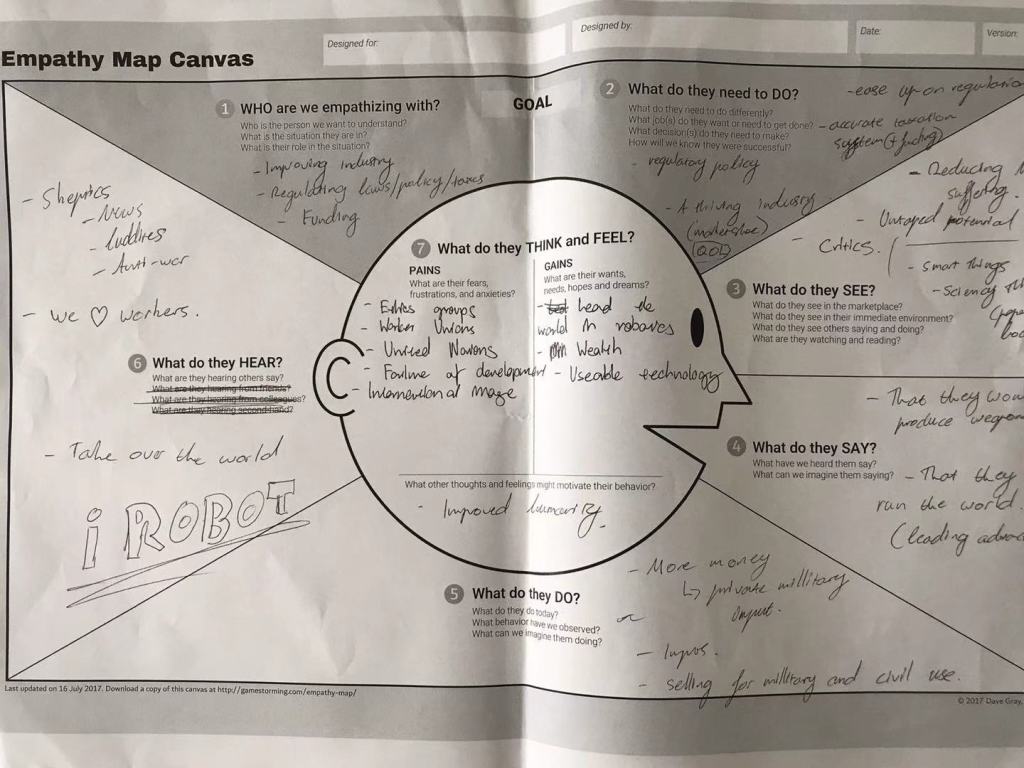
In the following draft our campaign outlined empathising with industry leaders and policy makers, as they have a stronger grasp in the technology industry, influence and most beneficial recipient. Auto-MATE campaign aimed ease up regulations controlling commercial “daily” automation to encourage a more efficiency within the workplace.
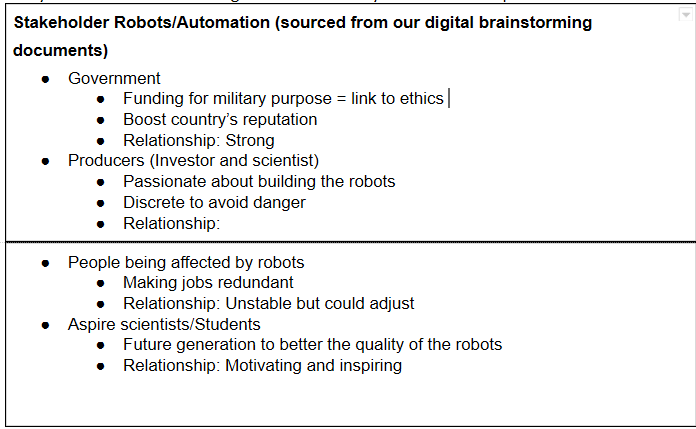
Our campaign wanted to clear up the stigma around automation within the employment sector to it will benefit our stakeholders – as automation cuts labour costs. However, we ran into our first communication problem as our objectives do not align with the objectives of stakeholders and target audience.

Our second brain storm, we shifted our perspectives and interests away from industry and governmental bodies and began thinking about representing the middle working class, young people (16 to 22) and technology sceptics – the target audience later changed to 16 to 20. Our purpose shifted away a financially driven objective to an awareness objective. We hope to establish a campaign that would address the fear of future unemployment.
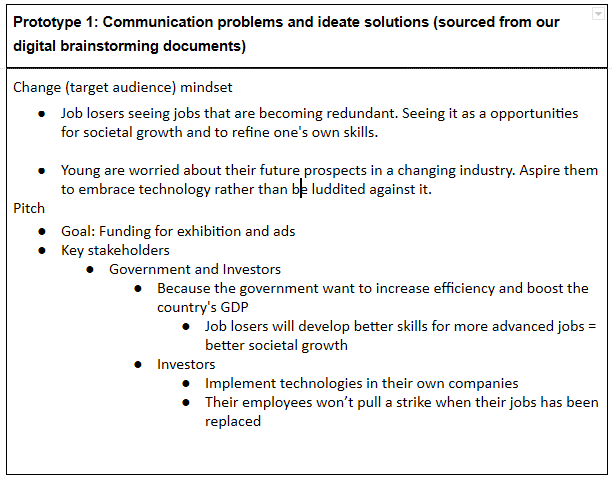
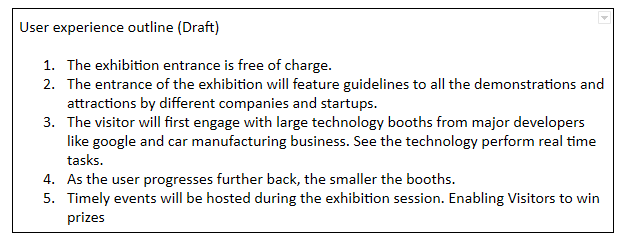
The first concept of our communication strategy was to host a community event in Melbourne’s exhibition centre to interact with new advancements in automation technology.
After the initial conception of our first idea, we received feedback from peers that our target issue is too generalised and fails to capture the attention of “sceptics”, because only technology enthusiasts would go to a technology related event. Unfortunately, our strategy had to be adjusted, and a new communication solution was constructed.
Based on verbal feedback received during our work in progress pitch(s). The Auto-MATE campaign was re-developed to respond to the fear and negative publicity in automation rather the addressing employment. Integrating advertising, online interactive content and an launch demonstration. Auto-MATE was redesigned to engage the wider Port Phillip community, including the sceptics.
Research Documentation
Photo by Viktor Talashuk on Unsplash
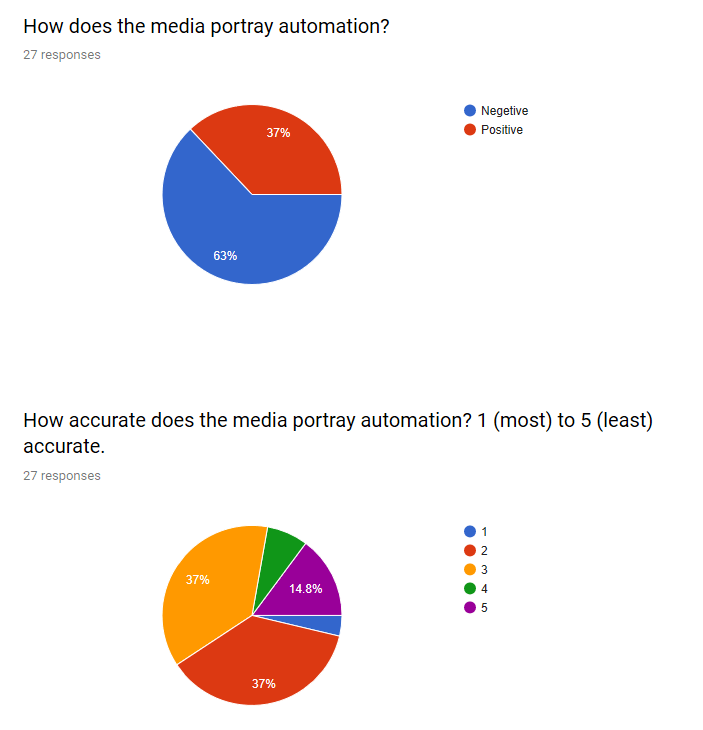
As apart of our research to determine the legitimacy of the fear for technology, a survey was created to outline the severity of the issue. Posted on various Facebook messenger boards, and face-to-face questioning, the 27 responses to our 5 questions confirmed our initial research that technology is portrayed negatively by the media.
Most notably, 55.6% of respondents has not engaged with technology related articles within the past week, yet majority (63%) respondents still suggest that the media negatively portrays technology.
Annotated Bibliography
Australian Government Department of Industry Innovation and Science, 2019, Artificial Intelligence: Australia’s Ethics Framework, Data61 CSIRO, viewed 5 December 2019, <https://consult.industry.gov.au/strategic-policy/artificial-intelligence-ethics-framework/supporting_documents/ArtificialIntelligenceethicsframeworkdiscussionpaper.pdf>
In a report commissioned by the Australian Department of Industry Innovation, outlines the various international policies used to ensure ethical practises with the adoption of automated processes, particularly in transportation. The core principles for AI include but are not limited to, generates net benefits, do no harm, comply with current regulatory and legal standards, ensure privacy and etc.
Useful for our research, the government reports outline current AI legal concerns through case studies and policies that aim to address them. It suggests that the fear of AI could have stemmed from recent accidents which human and machine accountability could not be differentiated.
Most importantly, the report illustrates that current level 4 automated vehicles and machines do comply with Australia’s National Transport Commission policy. With this information, we can establish our campaign and communication message in-line with supported government policy.
Congressional Research Service, 2019, Artificial Intelligence and National Security, CRS Report, viewed 6 December 2019, <https://fas.org/sgp/crs/natsec/R45178.pdf>
Acknowledging the rapid advancements in artificial intelligence and automation, especially in the commercial sector. Although most automated technology has not been adapted for military purposes, the United States of America, Congress has the ability to influence future military technology development.
In the commissioned report, it discusses the ethical implications of having fully autonomous vehicles. Notably, it outlines issues of privacy, threat to cyber space and “deep fakes” and possible solutions. Currently, the US adopts a similar set of AI principles to Australia, however that may soon change.
The current policy for Lethal Autonomous Weapons (LAWS) is being reconsidered allowing greater autonomy in both the industrial and military use vehicles – nothing has come to fruition.
Implementing into our research, the statistics provided by the report gives us indications of the rapid growth/interest in automated technology. If such growth is to be expected, then it is more apparent that the fear for the development of LAWS must be addressed.
References
Dastin, J, 2018. Amazon scraps secret AI recruiting tool that showed bias against women, Reuters, viewed on 04 December 2019, <https://www.reuters.com/article/us-amazon-com-jobs-automation-insight/amazon-scraps-secret-ai-recruiting-tool-that-showed-bias-against-women-idUSKCN1MK08G>
As part of our research, we must understand how the media currently portrays automation. An article published on Reuters outlines Amazon’s recruiting system has “taught itself” to preferably hire men, instead of women.
The main issue was that during the AI’s development, the data it was given to self improve, was screwed (unintentionally) to favour men. As a result of human error, the accountability was on behalf of the programmers who overlooked the data used.
Enforcing our previous research, the principle of AI accountability was overlooked by the media outlet, and the blame was shifted to the automated system and Amazon themselves. Amazon has since corrected their systems but the article author remains doubtful.
Wakabayashi, D, 2018. Self-Driving Uber Car Kills Pedestrian in Arizona, Where Robots Roam, The New York Times, March 19 2018, viewed 4 December 2019, <https://www.nytimes.com/2018/03/19/technology/uber-driverless-fatality.html>
Exploring the death of Elaine Herzberg, the first person to be killed by an automated car. The article digests the pursuing legal trials. On one hand, the article serves as a reminder for the public to fear technology, but on the other hand, it argues that self driving car policies should tighten.
What the author failed to acknowledge was that the death of Elaine Herzberg was due to human error. Although an intensive investigation of all vehicle components occurred following the incident. The supervising driver in the vehicle was responsible for the accident.
Despite it being a case of human error, the technology is poorly portrayed in the online publication. This article serves as further supporting evident to our targeted problem.
Wilshaw, P, 2018. The ethical automation toolkit, Towards Data Science, May 22 2018, viewed 4 December 2019, <https://towardsdatascience.com/the-ethical-automation-toolkit-f1fd4281534e>
The ethical automation toolkit is a rough guideline of ethics, agreed by the general scientific community, when adopting AI in the workplace and our everyday lives. As mentioned before, Australia and the United States adopt their own variations of this ethics guideline.
Through there are still more room for development. It outlines that all integrated automation aims to serve humanity’s interests, reduce harm and increase efficiency – which aligns with our communication purpose.
Manyika J, Chui, M, Miremadi, M, Bughin, J, George, K, Willmott, P, Dewhurst, M, 2017, Harnessing automation for a future that works, McKinsey & Company, January 2017, viewed 4 December, <https://www.mckinsey.com/featured-insights/digital-disruption/harnessing-automation-for-a-future-that-works>
Taking a more optimistic angle. The article provides an example of the positives of automation. From a brief historical perspective, it outlines industry development, growth in productivity throughout the early 2000’s.
Encouraging mutual cooperation between people and machines, particularly in areas requiring empathy. It outlines areas that require human intervention and manual assistance. Though many workers will lose their jobs in the process, it is more about a “shift” rather than a complete loss.
Despite not being a campaign to address the larger issue, it serves as a “starting” point that will assist the development of our campaign.
Holst A, 2018, Artificial Intelligence funding United States 2011-2018, September 13 2018, viewed 5 December 2019, <https://www.statista.com/statistics/672712/ai-funding-united-states/>
A graph sourced from Statista outlining the growth in AI funding in America. Aligning with the AI report by the US Congress, it suggests an increase trend in cooperation research and development in the field of automation.
It supports the idea that automation will continue to grow, and societal attitudes need to be addressed before further development.
Nona . K, 2019, Amazon warehouse discussed for site just minutes from the Lake Nona area, Lake Nona Social, May 2 2017, viewed 5 December, <https://lakenonasocial.com/amazon-warehouse-discussed-site-just-minutes-lake-nona-area>
As a part of our facebook/artefact mockup, the campaign sourced images from the following article
Nisen, M, 2014, Toyota is becoming more efficient by replacing robots with humans, Quartz, April 2014, viewed 5 December 2019, <https://qz.com/196200/toyota-is-becoming-more-efficient-by-replacing-robots-with-humans/>
Addressing the fear of redundancy in the car manufacturing, Toyota released a multiple press releases as a part of a public relations campaign, justify their minor loss in production efficiency.
Focusing on human centred design, the company believes by sacrificing efficiency for craftsmanship, it improves the car in ways no machine could.
Analysing Toyota’s PR campaign press release, the company promotes “human orientated skills” that require emotional thinking and niche expertise. For our campaign, we hope to encourage the same level of mutual cooperation between technology and society. By encouraging people to assist machines when performing emotional related tasks, it addresses the fear associated with technology.
Fernbach, N, Rafferty, S, 2018. Townsville Hospital hosts humanoid robot in Australian first trial, 28 August 2018, ABC News (Australian Broadcasting Corporation), viewed 10 December 2019, <https://www.abc.net.au/news/2018-08-24/townsville-hospital-trials-robot-helper/10157200>
In Townsville Australia, the first hospital social robot named “Pepper” was introduced as a simple “patient interaction” partner. Stemming from the lack of healthcare professional to answer simple patient questions. Pepper was introduced, programmed with information about the hospital and basic health knowledge.
The intention of robot was apart of the hospital’s plan to integrate online and digital visitor and patient assistance. However, it is currently seen as a “fun novelty” item to have rather than a healthcare assistant.
For our campaign launch, we hope to use robots as both a “novelty” and tool that can assist the Port Phillip community. By demonstrating some practical uses, like Townsville hospital with “Pepper”, the launch will gain public attention.
Teamwork Documentation
Photo by Campaign Creators on Unsplash
Production Planning
With our negotiated our ideas to form on cohesive campaign and communication strategy. This would later develop into a into the campaign timeline. It outlines the advertising scheduled. website launch and Auto-MATE’s campaign launch.
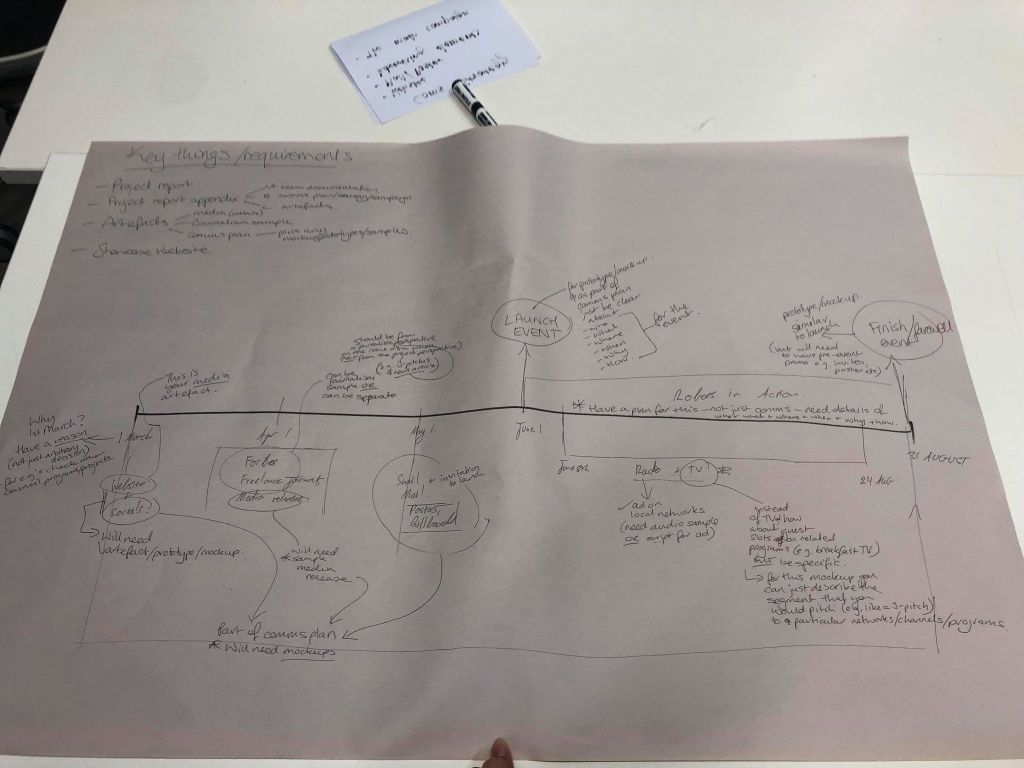
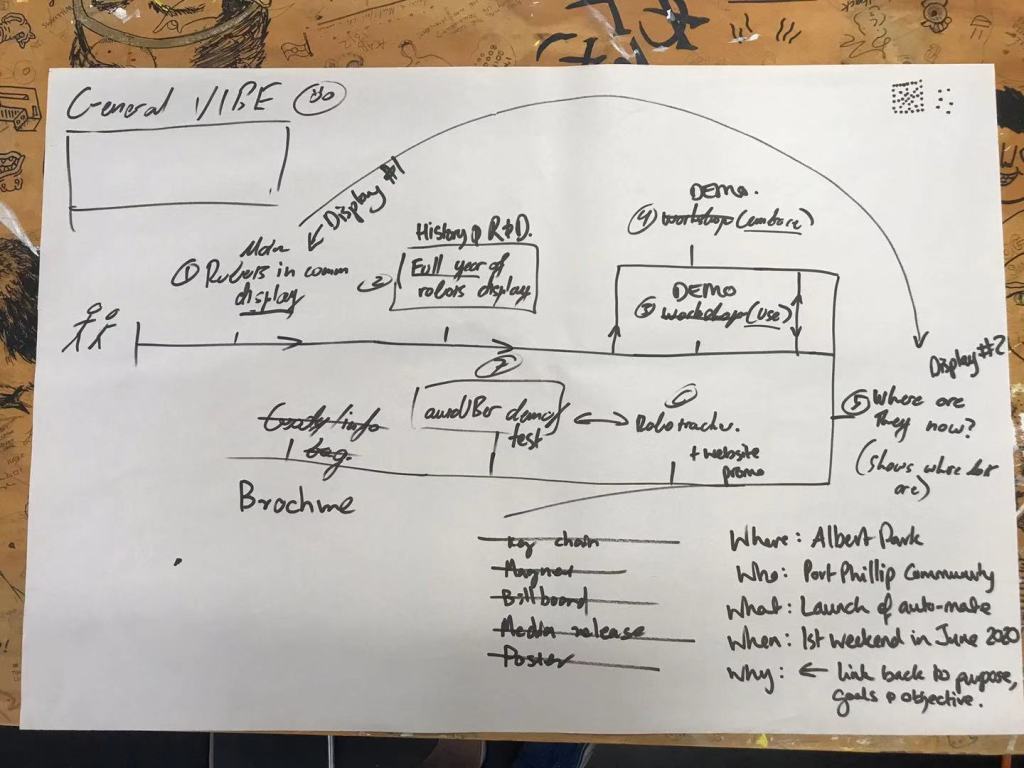
The development of our launch started rough. We had idea how to structure the launch so our group wrote our initial ideas onto a parchment paper. After further refining in a “map draft”, this later became the user experience chart.
A rough annotated user experience chart is available for download. It outlines the launch events rationale and intended (but removed final version) activities.
A project template, provided by Ella Chorazy, our tutor, was also used to divide workload and develop the campaign. Using the guides tabs and content recommendations, our group was able to roughly piece together a cohesive campaign.
Design Cooperation
Sharing our feedback between the artefact creators, our group can further adjust campaign materials like keychains and billboards for our communication strategy.

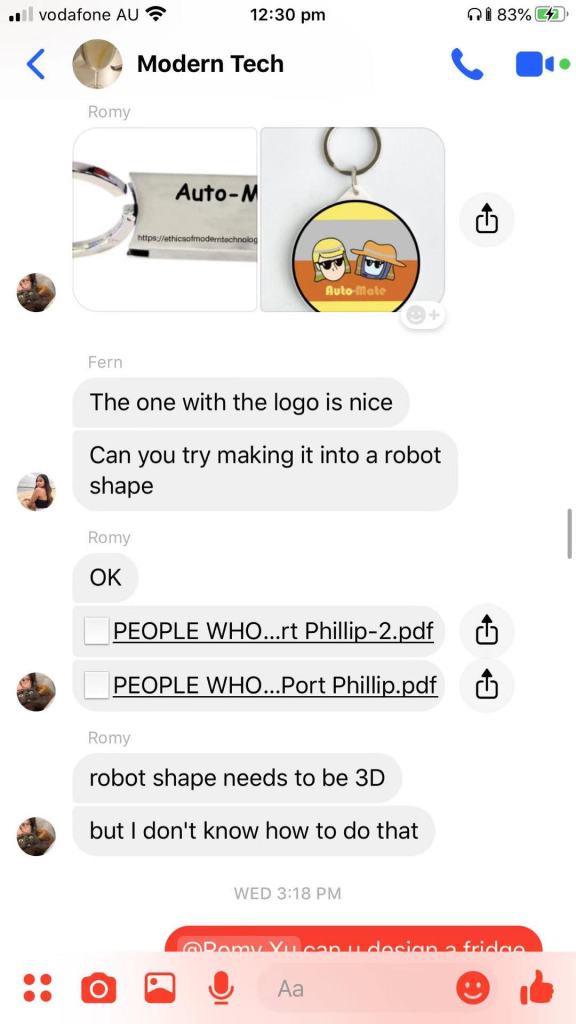
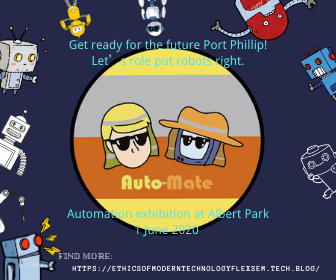
The following is a series of failed artefacts that had to be removed or re-adjusted. Originally the billboard was square, upon realising that commercial billboards are not usually square, but rather a rectangle, a new billboard was later re-designed with a clear font, appealing web address and our campaign launch location.
The keychain was too “bland” and was re-designed. Similarly, the poster had some grammatical errors and “did not make much sense” relating back to our communication strategy. Feedback was promptly provided to Romy, our media artefacts creator, guidance was provided to correct the mistakes.


Team Roles, Contract and Individual Reflections
William
Will is primarily tasked with key research and website development. Coordinating with the team he will both assist in overall project concept development as well as timeline coordination. Will has a key task in visual development and transfer to the website and other digital forms.
Fern
Fern is responsible for key strategizing for the communications plan. She is also responsible for all communications outputs and how they correspond with key project objectives. Fern also ensures all stakeholders are sufficiently reached and their issues satisfied.
Boris
Boris is in oversight of all written materials. Coordinating with the research team he must sufficiently reflect group optupts in verbal means. Boris then coordinates with the visual team to ensure all project artifacts correspond. Boris also partakes in key project concept development and planning.
Romy
Romy is responsible for the major project insights. Romy must coordinate these insights with the team to provide visual and written equivalents. Romy is also responsible for info graphics, ensuring that they indeed represent key research findings.
Meeting Times
Monday 16th December, Building 9: 3 hours
Wednesday 18th, December, State Library: 2 and a half hours
Thursday 19th, December, Building 9: 3 hours
Peer Feedback
Following the first work in process presentation, our feedback suggests we have a firm understanding of our topic. However, the there was no clear proposed solution and the stakeholder/target audience needs refinement.
For our second work in progress pitch, our main concern was not showing enough evidence to support our intended target audience, and the proposed solution was too generalised.
Mentioned in project Ideation, Auto-MATE was re-developed with the received feedback in mind. For our presentation materials, please scroll down to “Presentation Materials” section.
Download Presentation Materials
Other Useful Links!
Project report is available for download on the “Home” page.
 Site Title